Glossary
Volume discount: what it is, how to calculate it and how to offer one in your store
A volume discount is a lower price for buying more at once: 10% off 3 or more units, 15% off 6 or more. This page covers the forms it takes, how to work out unit price, total and margin, what to watch in your promotion copy, and how to set one up in your own Shopify store.
1 What is a volume discount?
A volume discount is a lower price in return for a larger purchase. The Corporate Finance Institute describes it as discounted prices that encourage a customer to buy a product in large quantities at once.
In an online store it usually means: from a certain number of units in the cart, each unit gets cheaper. With several thresholds you have tiers. How tiered pricing and volume pricing differ when you calculate them has its own page.
For you, shipping, packaging and payment fees get spread across more units per order. The customer pays less per unit.
2 Volume discount, quantity discount, buy X get Y
The words overlap. The Corporate Finance Institute separates them: a volume discount rewards buying many units, while a quantity discount doesn't have to involve large numbers. Its example of a quantity discount is a buy one, get one free deal at retail.
There is also a choice in the form. With a price cut, the price per unit drops. With free units, the price stays and the customer gets extra units at no charge, as in buy 2, get 1 free.
Whether variants or different products count together is the biggest decision when you set one up. The options are in how to count per product or per collection. In a store you'll mostly meet three forms:
| Form | Example | What counts |
|---|---|---|
| Per product | 10% off 3 or more bags of the same coffee | units of one product |
| Across products | 10% off any 3 items from the Coffee collection | all units in the selection together |
| Free units | buy 2, get 1 free | units, rewarded with a free item |
3 The formula: unit price, total, discount rate
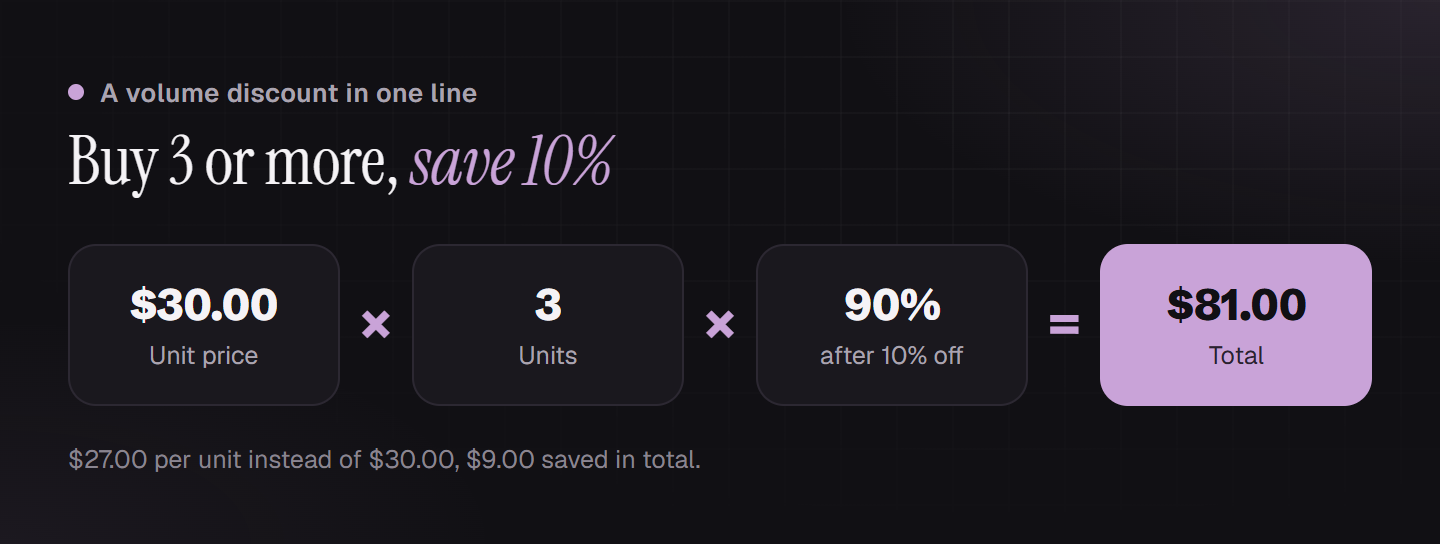
A percentage volume discount takes two steps. First the new unit price: unit price × (1 − discount). Then the total: quantity × new unit price.
Example: a product sells for $30.00, with 10% off 3 or more. The unit price drops to $30.00 × 0.9 = $27.00. Three units cost $81.00 instead of $90.00, so the customer saves $9.00.
To get the discount rate from two prices, work backwards: (old price − new price) ÷ old price. $30.00 and $27.00 give $3.00 ÷ $30.00 = 10%.
With uneven prices, rounding matters. Shopify calculates a percentage discount per unit and rounds down to the cent. Measured in a real checkout: 10% off $749.95 gives $74.99 off per unit, not $75.00. The tiered discount calculator does the same.
4 What a volume discount does to your margin
The discount comes straight out of your gross profit, the part left after your cost. Use prices before sales tax. Say the $30.00 from the example is your selling price and the item costs you $18.00.
10% off the price costs you a quarter of your gross profit per unit here: $9.00 instead of $12.00. At a 40% margin and 10% off, you need to sell about a third more units to keep the same gross profit, because 10 ÷ (40 − 10) comes to 0.33. Whether that happens depends on how many customers buy more because of the tier and how many would have bought three anyway. The full calculation, with a table for different margins, is in Is a volume discount worth it?
| Feature | 1 unit | 3 units, no discount | 3 units, 10% off |
|---|---|---|---|
| Price per unit | $30.00 | $30.00 | $27.00 |
| Total | $30.00 | $90.00 | $81.00 |
| Gross profit | $12.00 | $36.00 | $27.00 |
| Margin | 40% | 40% | 33.3% |
5 What to watch in your promotion copy
Volume discounts are an ordinary part of pricing. What regulators look at is how you describe them. This is a summary for US stores, not legal advice, and state rules and the rules of other countries you sell to can add to it.
- Free means free. For buy 2, get 1 free, the FTC's guide on the word free (16 CFR 251) says you may not recover the cost of the free item by raising the price of the items the customer has to buy.
- Conditions up front. The same guide asks for every condition of a free offer to be stated clearly and conspicuously at the outset. A footnote reached through an asterisk does not count as disclosure at the outset.
- Show what checkout charges. The savings on the product page should match exactly what checkout takes off. Check uneven prices in particular, because of the rounding per unit.
6 Volume discounts in Shopify without an app
Shopify has two discount types for this. For a price cut, you create an amount off products discount and set minimum quantity of items as the requirement. If the discount covers specific products or a collection, only those count toward the minimum, and the discount applies to every eligible item.
The field takes one value, so one discount is one tier. For 10% off 3 or more and 15% off 6 or more, you need two automatic discounts. For tiered discounts, Shopify's help center points to apps from the App Store, and to Checkout Blocks for stores on Shopify Plus.
Free units such as buy 2, get 1 free work with a buy X get Y discount set to free. According to Shopify, the free item is never added to the cart automatically. The customer has to add every unit themselves.
7 Volume discounts with Hand-E AI Discounts
The Volume tiers discount type keeps every tier in one discount, each higher than the last. Tiers use a percentage or a fixed amount, and only percentages when everything in scope counts together. The counting option decides what adds up: each cart line on its own, a product with all its variants, or everything in scope.
Before you save, you build a test cart with real products in the preview. It calculates line by line the way Shopify's checkout does. A widget shows the tiers on the product page, with the price for each quantity. All five discount types and the AI assistant are included in every plan, the Free plan too.

Sources
- Corporate Finance Institute: Volume Discount, 2020(opens in a new tab)
- 16 CFR 251.1: Guide Concerning Use of the Word “Free” (Legal Information Institute)(opens in a new tab)
- Shopify Help Center: Amount off discounts (minimum quantity of items)(opens in a new tab)
- Shopify Help Center: Discount types (tiered discounts through apps or Checkout Blocks)(opens in a new tab)
- Shopify Help Center: Buy X get Y discounts(opens in a new tab)
- Shopify Help Center: Automatic discounts (25 active at most)(opens in a new tab)
Common questions
What is a volume discount?
How do I calculate a volume discount?
Is a volume discount the same as buy X get Y?
What does the FTC say about buy one, get one free offers?
Related reads
Is a volume discount worth it?
The formula for the extra units you need, a worked example, and the cases where a tier brings in more than it costs.
Read moreMultiple quantity breaks don't fit in one discount
In Shopify's discount form, you set one minimum purchase requirement with one value. So each discount has one threshold. For 10% off 5 or more items and 15% off 10 or more, you need two separate automatic discounts. Or you use an app that keeps every tier in one discount.
Read moreTiered pricing calculator
Enter unit price, cost and your tiers: price, margin and extra volume needed per tier, to the cent the way Shopify's checkout does it.
Read more