Tips for your store
Is a volume discount worth it? How to do the margin math
10% off when you buy three or more sounds generous. Whether it pays off depends on a number many never work out: how many more units do you need to sell to keep the same gross profit? The math takes two minutes.
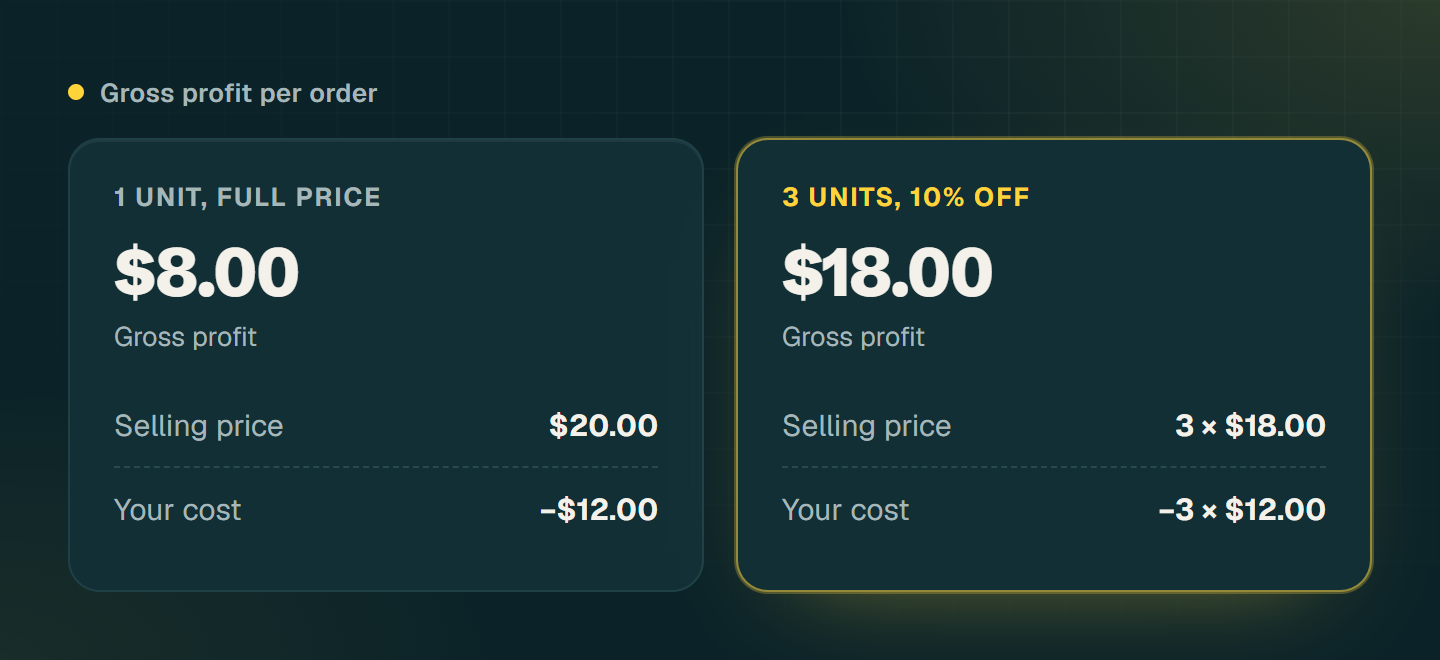
1 Think in gross profit, not revenue
A discount doesn't take 10% of your profit, it takes 10% of the price. And all of that comes out of your gross profit.
Example: a product sells for $20, you buy it for $12. You keep $8, a 40% margin. At 10% off you sell it for $18 and keep $6. The price drops by a tenth, your gross profit by a quarter.
2 The formula: discount divided by margin minus discount
How many more units you need to sell to keep the same gross profit comes from one simple calculation: discount ÷ (margin − discount). At a 40% margin and 10% off that is 10 ÷ 30, so about 33% more units. It is standard pricing math, set out for example in CFO Magazine.
The table shows how fast that grows. With a thin margin, a big discount eats most of your gross profit.
| Discount | Margin 30% | Margin 40% | Margin 50% | Margin 60% |
|---|---|---|---|---|
| 5% | +20% | +14% | +11% | +9% |
| 10% | +50% | +33% | +25% | +20% |
| 15% | +100% | +60% | +43% | +33% |
| 20% | +200% | +100% | +67% | +50% |
3 A tier is not a discount on everything
This is the difference from a store-wide percentage off: with a tier, a customer who buys one unit pays full price. The discount only costs you on orders that reach the threshold.
So the real question is: how many of your customers would have bought three anyway? Every customer who goes from one to three units because of the tier brings you $10 more gross profit in the example ($18 instead of $8). Every one who would have taken three anyway costs you $6 ($18 instead of $24).

4 Count the costs per order
Packaging, shipping and payment fees come per order, not per unit. Card fees usually include a fixed amount per transaction; on Shopify Payments it's a percentage plus a fixed fee that depends on your country and plan. Say everything together comes to $4.50 per order: an order with one unit then brings $3.50, one with three units at 10% off brings $13.50.
The higher your fixed costs per package, the sooner a tier pays off. For heavy or bulky goods that is often the strongest reason for one.
5 Put the first tier just above what people buy today
Look at your orders from the last few weeks. If a typical customer buys one unit, the first tier sits at two or three. If many already buy two, start at three. A tier almost everyone reaches anyway is just a price cut. But don't set it too high either: a study of multi-unit promotions in retail found that the required quantity was often too high to get shoppers to buy more.
Two or three tiers are usually enough. More than that gets hard to read on a product page.
6 Show the savings where the decision happens
A tier the shopper only notices at checkout no longer changes the decision. It belongs on the product page, with the price per unit for each quantity. Then they see what each unit costs when they buy three or more, before adding to cart.
7 Check what happened after four weeks
Compare two periods: units per order, gross profit per order and the number of orders. If your total gross profit goes up, the tier pays off. If only the units go up while total gross profit falls, the tier is too low or the discount too high.
To run the numbers for your store, use the tiered discount calculator. It works out unit price, margin and the extra units needed per tier, to the cent like Shopify's checkout.
Sources
- Thomas E. Conine: Should You Cut Volume or Price?, CFO Magazine, 2013(opens in a new tab)
- Ailawadi, Harlam, César, Trounce: Quantifying and Improving Promotion Effectiveness at CVS, Marketing Science 26(4), 2007(opens in a new tab)
- Foubert, Gijsbrechts: Shopper Response to Bundle Promotions for Packaged Goods, Journal of Marketing Research 44(4), 2007(opens in a new tab)
- Shopify: Pricing and fees (Shopify Payments)(opens in a new tab)
- Shopify Help Center: Amount off products (minimum quantity)(opens in a new tab)
Common questions
How many more units do I need to sell at 10% off?
Do I calculate the margin with or without sales tax?
Is a volume discount better than a store-wide discount?
Related reads
Tiered pricing calculator
Enter unit price, cost and your tiers: price, margin and extra volume needed per tier, to the cent the way Shopify's checkout does it.
Read moreMultiple quantity breaks don't fit in one discount
In Shopify's discount form you pick one minimum purchase requirement with one value, which means one threshold per discount. For 10% off 5 or more items and 15% off 10 or more, you need two separate automatic discounts natively, or an app that keeps every tier in one discount.
Read moreWhich discount type fits which goal?
Higher order value, more units, new customers, clearing stock: the discount type that fits each goal, with and without an app.
Read more