Glossary
Tiered pricing vs volume pricing: same tiers, two different totals
Tiered pricing and volume pricing both lower the price per unit as the quantity goes up. They differ in one detail: does the tier price apply to every unit, or only to the units inside that tier? With the same price table, 12 units cost $96 one way and $109 the other. Here is how each one works and which one fits your store.

1 The price table both models share
Both models start from the same thing: a price table where the price per unit drops at certain quantities. They differ only in how a quantity is priced once it crosses a threshold.
The examples on this page use a table with three tiers:
| Quantity | Price per unit |
|---|---|
| 1 to 4 units | $10.00 |
| 5 to 9 units | $9.00 |
| 10 or more units | $8.00 |
2 Volume pricing vs tiered (graduated) pricing
With volume pricing, the whole quantity is priced at the tier it falls into. 12 units reach the tier from 10, so all 12 cost $8.00 each: $96.00 in total. Stripe's billing docs put it the same way: the entire quantity is multiplied by the unit cost of the tier.
With tiered pricing in the strict sense, also called graduated pricing, only the units inside a tier get that tier's price. Units 1 to 4 cost $10.00, units 5 to 9 cost $9.00, units 10 to 12 cost $8.00. That makes $40.00 + $45.00 + $24.00 = $109.00 for 12 units, about $9.08 per unit.
Up to the first threshold both give the same total. After that, volume pricing is always cheaper for the buyer with the same table:
| Quantity | Volume pricing | Tiered (graduated) |
|---|---|---|
| 4 units | $40.00 | $40.00 |
| 5 units | $45.00 | $49.00 |
| 9 units | $81.00 | $85.00 |
| 10 units | $80.00 | $93.00 |
| 12 units | $96.00 | $109.00 |
3 Why the names get mixed up
The two terms aren't used consistently. Stripe uses tiered pricing as the umbrella term, with two modes under it: volume and graduated. Chargebee's documentation uses tiered for the graduated model and volume for the model that prices every unit at one tier. Chargebee's glossary notes that the two are often used interchangeably.
Our own guide to tiered pricing in Shopify uses the word in that looser sense, for quantity breaks that apply to every unit. Before you compare two offers or two apps, check which calculation is meant. The totals differ.
4 The price cliff in volume pricing
Volume pricing has a quirk. At every threshold the whole quantity gets cheaper, so the total can drop while the quantity rises. Stripe's docs say so plainly: because the tier price applies to the entire quantity, the total might decrease. In the table above, 9 units cost $81.00 and 10 units only $80.00.
That is the incentive at work: someone who wants 9 takes 10. Still, check the jump at each threshold before you go live, and decide if you want it that big. With graduated pricing the total rises with every unit, so there is no cliff.
5 Which one fits your store
Volume pricing is easier to show and to read: from 10 units, every unit costs $8.00. The saving at each threshold is bigger, which makes the next tier more attractive, and it costs you margin on every unit in the order.
Graduated pricing gives smaller savings and keeps the full price on the first units. It is harder to show on a product page, because the average price per unit depends on the exact quantity.
Whichever you pick, work out what each tier costs you first. If you'd rather reward a bigger cart than more units of one product, see tiered discounts by order value. Selling to businesses? Shopify's B2B catalogs have their own volume pricing, compared in B2B volume pricing vs quantity discounts.
6 Tiered and volume pricing in Shopify
Shopify's amount off products discount takes one minimum quantity and applies to every eligible item. That is volume pricing with one tier per discount. For three tiers you create three automatic discounts.
Volume tiers in Hand-E AI Discounts also use volume pricing, with every tier in one discount: the tier reached applies to every counted unit. The app does not offer graduated pricing, where only the units above a threshold get cheaper. You enter the example price table as a fixed amount off per unit: $1.00 from 5 units, $2.00 from 10 units.
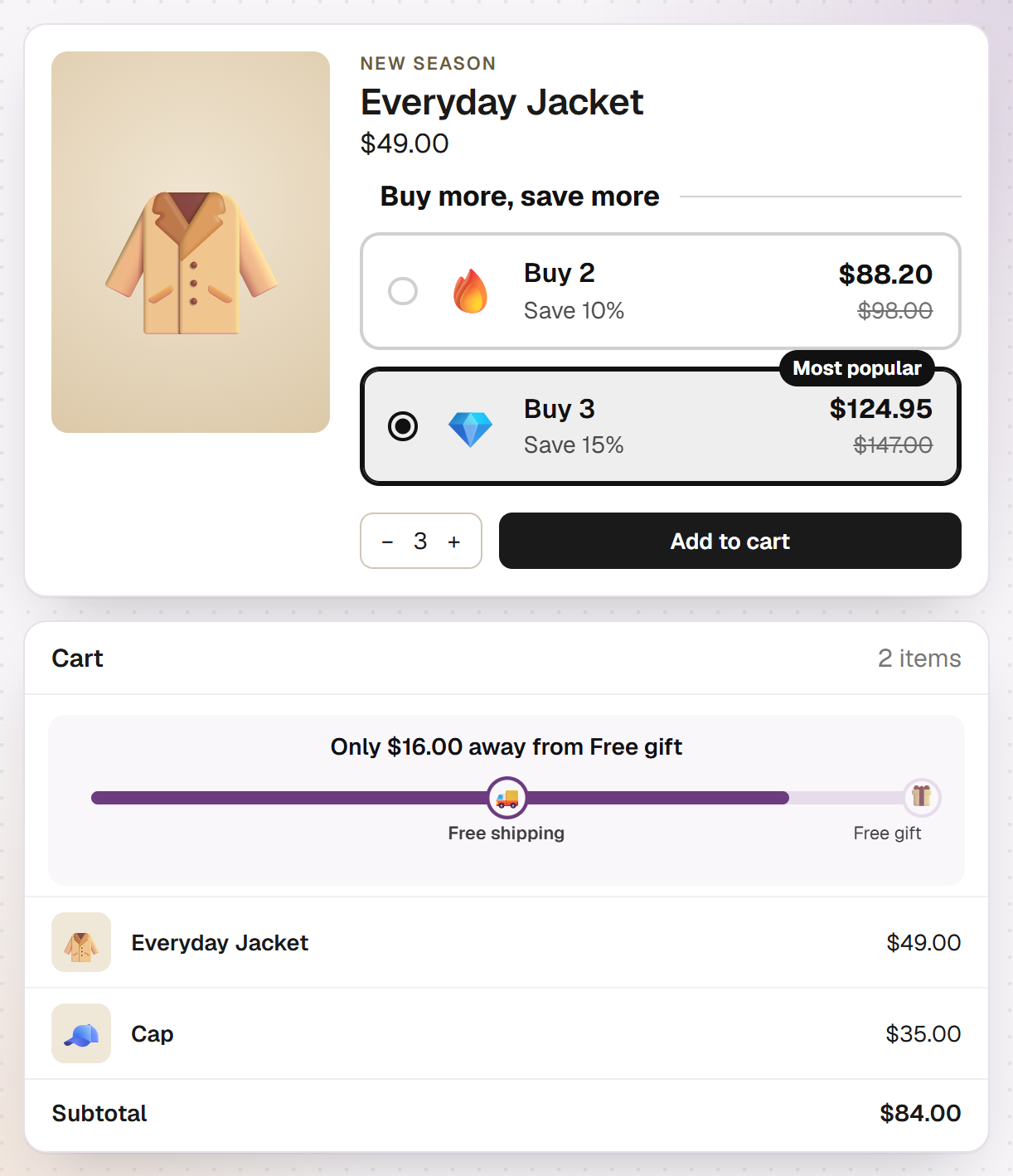
Show the tiers close to the price and the add to cart button, with the quantity, the price and the saving for each tier, and say which products count. For the full setup, see Shopify tiered pricing with quantity breaks.
Sources
- Stripe Docs: Set up tiered pricing (volume-based and graduated pricing)(opens in a new tab)
- Chargebee Docs: Pricing models available for plans, addons and charges(opens in a new tab)
- Chargebee Glossary: Tiered pricing model(opens in a new tab)
- Shopify Help Center: Amount off discounts (minimum quantity of items)(opens in a new tab)
- Shopify Help Center: Volume pricing in B2B catalogs(opens in a new tab)
Common questions
What is the difference between tiered pricing and volume pricing?
Is graduated pricing the same as tiered pricing?
Can a bigger order cost less with volume pricing?
Does Hand-E AI Discounts use volume or graduated pricing?
Related reads
Multiple quantity breaks don't fit in one discount
In Shopify's discount form, you set one minimum purchase requirement with one value. So each discount has one threshold. For 10% off 5 or more items and 15% off 10 or more, you need two separate automatic discounts. Or you use an app that keeps every tier in one discount.
Read moreTiered pricing calculator
Enter unit price, cost and your tiers: price, margin and extra volume needed per tier, to the cent the way Shopify's checkout does it.
Read moreBusiness customers need other price breaks than shoppers
Shopify's B2B volume pricing gives business customers fixed unit prices above a certain quantity, counted per variant. According to the changelog, it runs on Basic, Grow and Advanced since April 2026. Volume tiers from Hand-E AI Discounts give shoppers in your online store a percentage or fixed amount off. They can also count variants together.
Read more