Guide
Quantity discounts: count per line, per product, or all together
A native Shopify discount with a minimum quantity of items counts the eligible items together. If each product should count for itself, with its variants added up, you need one native discount per product or volume tiers with a counting mode you can choose.
Same tiers, three different results
10% off from 5 items sounds clear. It is not: if someone buys 3 T-shirts in S, 2 T-shirts in M and 4 hoodies, you can count 3, 2 and 4, or 5 and 4, or 9. Depending on the count there is no discount at all, a discount on the T-shirts, or a discount on everything.
Which count is right depends on your catalog. A fashion store usually wants the sizes of one shirt to count together. A specialty food shop with mix and match wants every jar in a collection to count together. If your variants sit at very different prices, you may want each variant counted separately.
Shopify's help on discounts for products describes no separate setting for this. When a discount applies to specific products or collections, exactly those items contribute to the minimum quantity. If you want to count differently, you steer it through the way you cut your discounts.
| Shopify native | With Hand-E Discounts | |
|---|---|---|
| Everything in scope together (mix and match) | one discount with a minimum quantity on products or a collection | counting mode everything in scope together, percentages |
| Variants of a product together | a separate discount per product | counting mode all variants of a product together |
| Each cart line for itself | not described in the discount help | counting mode each cart line on its own |
| Several tiers | one discount per tier | as many tiers as you like in one discount |
Native: the counting sits in the way you cut the discount
Because a native discount counts the eligible items together, you decide the counting through what the discount applies to.
- Mix and match in a collection: An automatic discount on the collection with a minimum quantity of 5 counts the items of that collection together. For a single tier, that is a fitting native route.
- Per product: If each product should count for itself, create one discount per product that covers just that product. Its variants then count together. With 12 products, that is 12 discounts.
- Slots: Shopify allows at most 25 active automatic discounts, app discounts included. One discount per product and per tier runs into that limit quickly.
- Overlaps: If a product sits in two collections that each have their own discount, the discounts compete. When they are not allowed to combine, Shopify applies the one with the larger benefit for the cart.
- B2B volume pricing: It counts per variant. A business customer has to reach the quantity for each variant separately, so the sizes of a shirt do not count together there.
How to pick the counting mode in Hand-E Discounts
In Volume tiers, the counting mode is a setting of its own. What gets discounted and how items are counted are two separate decisions.
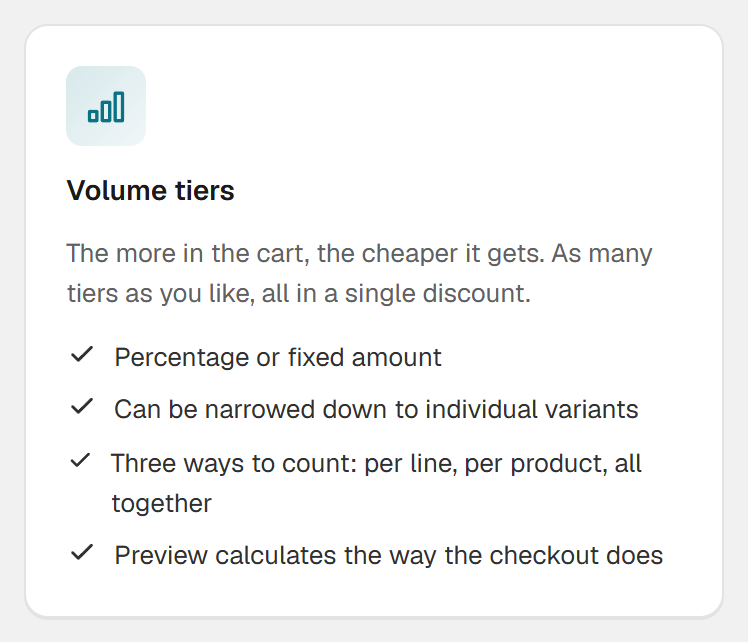
- Create Volume tiers and choose what they apply to: all products, collections, individual products or individual variants, mixed if you like.
- Choose each cart line on its own when every line should reach the tier by itself.
- Choose all variants of a product together when sizes and colors of one product should count together.
- Choose everything in scope together for mix and match. The tier that is reached then applies to every line in scope. Here you can use percentage tiers, not fixed amounts.
- Rebuild exactly the cart you are unsure about in the cart preview. For each line it shows whether the tier applies, how many items are still missing, or that the line is not in scope.
Worked example: one cart, three counting modes
Tier: 10% off from 5 items. Scope: the Tops collection. The cart holds a $19.90 T-shirt in S (3 items) and in M (2 items) plus 4 hoodies at $49.90. Cart total: $299.10. Discount per item, truncated to the cent: $1.99 per T-shirt, $4.99 per hoodie.
| Counting mode | Counted | Tier applies to | Discount | To pay |
|---|---|---|---|---|
| each cart line on its own | 3, 2 and 4 | no line | $0.00 | $299.10 |
| all variants of a product together | T-shirt 5, hoodie 4 | 5 T-shirts | $9.95 | $289.15 |
| everything in scope together | 9 | all 9 items | $29.91 | $269.19 |
Limits and pitfalls
- Under everything in scope together there is no fixed amount, just percentages.
- A fixed amount can be taken off per item or once per cart line. Once per cart line means: a line with 10 items gets the amount once, not ten times.
- A wide scope with everything in scope together turns cheap items into leverage: someone who buys 4 hoodies reaches the tier for all 5 items by adding one T-shirt. Pick the scope deliberately.
- The preview knows nothing about other discounts, schedules, customer groups, markets, taxes or shipping.
- Volume tiers take up one of the 25 slots for active automatic discounts, no matter how many products they cover.
Common questions
What does mix and match mean for a quantity discount?
How do I keep cheap items from unlocking the tier for expensive ones?
Why does the cart preview say a line is not in scope?
Can one quantity discount cover a collection and individual products at once?
Related problems
Multiple quantity breaks don't fit in one discount
In Shopify's discount form you pick one minimum purchase requirement with one value, which means one threshold per discount. For 10% off 5 or more items and 15% off 10 or more, you need two separate automatic discounts natively, or an app that keeps every tier in one discount.
Read moreBusiness customers need other price breaks than shoppers
Shopify's B2B volume pricing gives business customers fixed unit prices above a quantity, counted per variant, and according to the changelog it runs on Basic, Grow and Advanced since April 2026. Volume tiers from Hand-E Discounts work in percentages or fixed amounts for shoppers in your online store and can count variants together.
Read moreThe discount is set up but does not apply at checkout
When a Shopify discount does not apply, start with its own conditions and with Shopify's rules for how discounts interact: combinations, minimum purchase requirements, customer eligibility, active dates, and the limit of 25 active automatic discounts. Walk through the points in order, then check the result with a test order.
Read more