Tips for your store
Ecommerce promotion calendar: a year plan for Shopify merchants
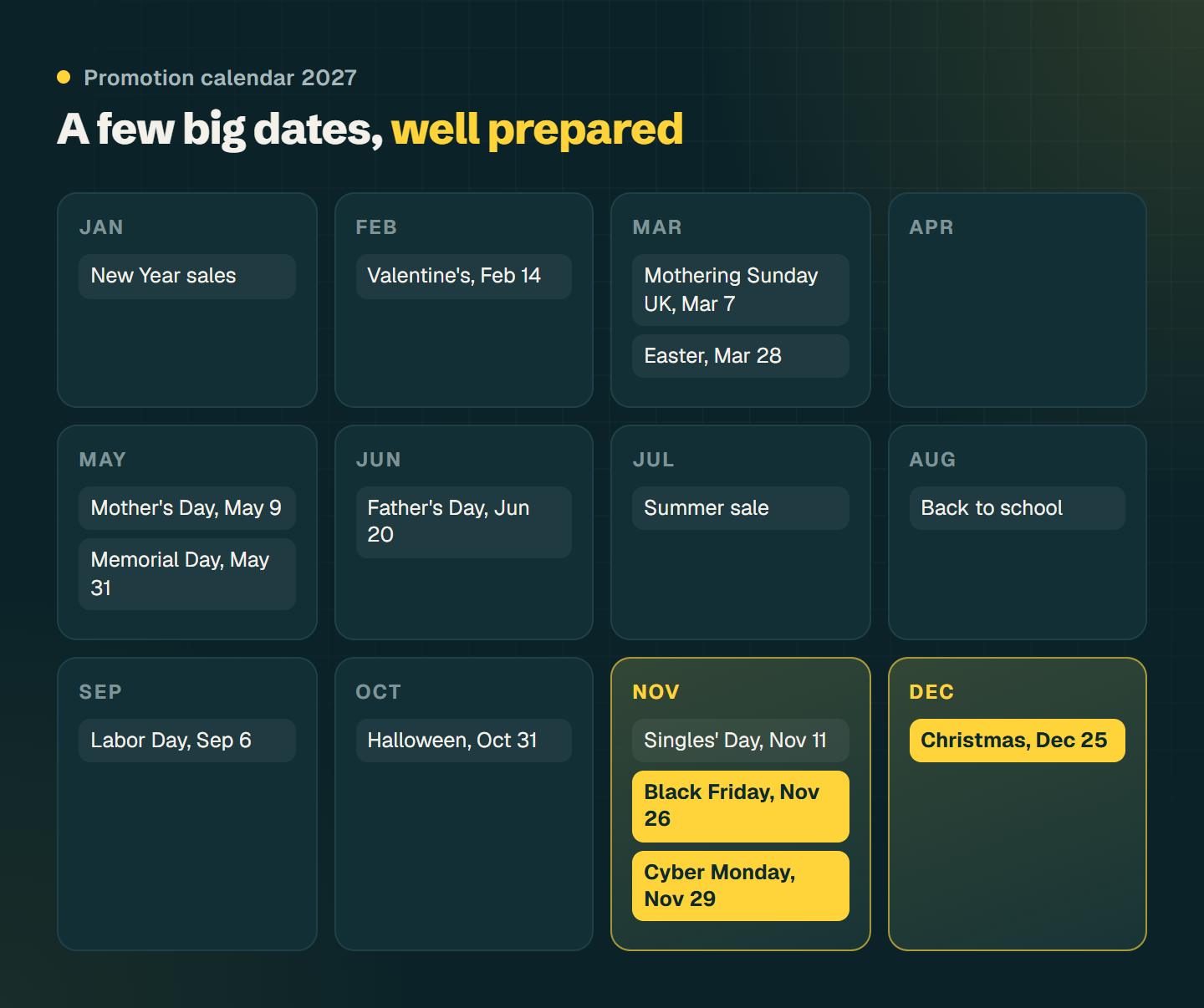
Run a discount every month and you can teach customers to wait for the next one. A few fixed events a year, well prepared, make more sense, with offers in between that don't cut prices. Here are the dates to the end of 2027 for the US, UK and Germany.
1 Pick a few anchors instead of twelve sale weeks
Deep discounts have a price that shows up later. In three large field experiments at a US catalog retailer, deeper discounts brought more future purchases from new customers but fewer from established ones. One plausible explanation: customers who are used to discounts wait for the next one.
So pick a few events that fit what you sell and prepare them properly. Between the anchors, work with gifts, gift wrap or gift cards instead of percentages.
2 The dates for late 2026 and 2027
Fixed and movable dates at a glance. Easter also determines several spring dates.
| Event | 2026 | 2027 |
|---|---|---|
| Singles' Day | Wed, Nov 11 | Thu, Nov 11 |
| Thanksgiving (US) | Thu, Nov 26 | Thu, Nov 25 |
| Black Friday | Fri, Nov 27 | Fri, Nov 26 |
| Cyber Monday | Mon, Nov 30 | Mon, Nov 29 |
| Christmas Eve | Thu, Dec 24 | Fri, Dec 24 |
| Valentine's Day | Sun, Feb 14 | |
| Mothering Sunday (UK) | Sun, Mar 7 | |
| Easter Sunday | Sun, Mar 28 | |
| Mother's Day (US, Germany) | Sun, May 9 | |
| Memorial Day (US) | Mon, May 31 | |
| Father's Day (US, UK) | Sun, Jun 20 | |
| Labor Day (US) | Mon, Sep 6 |
3 Every event has its own kind of purchase
Look at what people actually buy for each event before you plan it. Germany's retail association HDE publishes this: for Mother's Day 2026, flowers led, followed by food, perfume and cosmetics, and clothing. For Easter it was food, decoration, toys and flowers.
Don't rank events by size across different studies; they measure different things. Use such lists to decide which events fit what you sell.
4 Work backwards from every date
An event doesn't start on its date. A common sequence: announce two to three weeks before, show your shipping cutoff three to five days before, and in the last two days, promote gift cards delivered by email to last-minute shoppers.
5 Space real price cuts at least 30 days apart in the EU
If you sell in the EU, every compare-at price has to refer to the lowest price of the last 30 days. That chains your promotions: the Black Friday week price becomes the reference for Christmas, a Christmas price the reference for January.
6 Father's Day isn't the same date everywhere
In the US and UK, Father's Day is the third Sunday in June, June 20 in 2027. In Germany it falls on Ascension Day, a Thursday in May: May 6 in 2027. Selling in several countries means separate campaigns.
In Shopify you can limit a discount to specific markets, so the German promotion runs in May and the US one in June.
7 Test Singles' Day on a small scale
In 2026, November 11 is only 16 days before Black Friday. A deep store-wide discount that day can undercut your own Black Friday week. If you use it, make it a small offer limited to 24 hours, such as a free gift over a set order amount.
8 Set up promotions in Shopify ahead of time
Discounts in Shopify have start and end times in your store's time zone. So set up next quarter's promotions in advance and check them without time pressure, not on the morning of the event. You can duplicate last year's discounts instead of rebuilding them. Natively, scheduling price changes on products requires Launchpad, which is available only on Shopify Plus.
Sources
- Anderson, Simester: Long-Run Effects of Promotion Depth on New versus Established Customers, Marketing Science 23(1), 2004(opens in a new tab)
- HDE: Mother's Day (German)(opens in a new tab)
- HDE: Easter 2026 (German)(opens in a new tab)
- Adobe: Holiday shopping season 2025 results (2026)(opens in a new tab)
- EU Directive 98/6/EC, Article 6a on price reductions (added by the Omnibus Directive 2019/2161)(opens in a new tab)
- Shopify Help Center: Discounts and markets(opens in a new tab)
- Shopify Help Center: Managing discounts (duplicate, deactivate)(opens in a new tab)
- Shopify Help Center: Launchpad (Shopify Plus only)(opens in a new tab)
Common questions
When is Father's Day 2027?
When is Black Friday 2027?
How many sales events should a store run per year?
Related reads
Black Friday checklist
Dates for 2026, compare-at prices, testing discounts, limiting codes: the checklist for Black Friday and Cyber Monday.
Read moreMargin-safe holiday promotions
Gifts instead of percentages, gift cards for late shoppers, clear shipping cutoffs and returns that keep their promise.
Read more5 costly discount mistakes
No margin math, constant sales, stacked codes, leaked coupons, risky price claims: five mistakes and how to avoid them.
Read more